All companies have processes. They can be formal or informal, supported by an IT system(s) or not. However, many companies, regardless of their size, do not make the most of their processes to really learn from them and drive improvement. Here are some food for thoughts to develop a methodology for improvement.

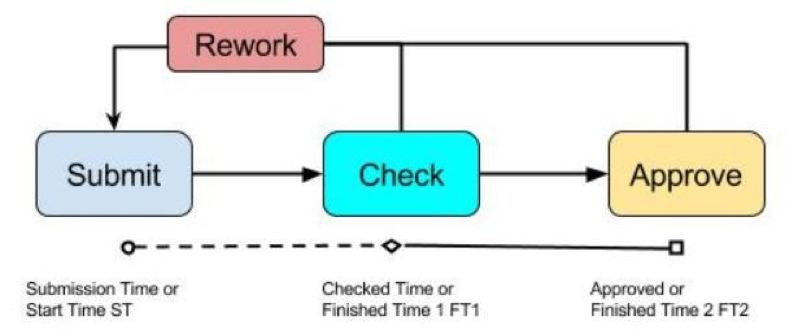
Let’s take a very simple process for approving documents:

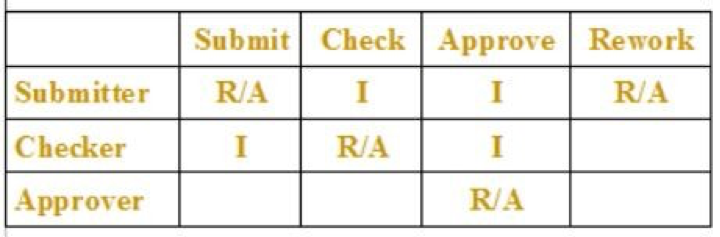
and a RACI matrix is also created. eg:

This is nicely documented in the company QMS and this will therefore tick the box of an ISO 9001 audit. After all a process is defined and the staff knows it.

However, how is it used in practice?

Do people print out the document and give it to the Checker, or maybe send him/her an email with an attachment asking him or her to check it?

  • How can the performance of this process be measured?
  • How can the staff competence be improved?
  • How do you ensure the right technology is used to support it?

Let’s see how those questions can be answered.

This process can teach us the following:

  1. Duration (lead time) for the document to be approved.
  2. Number of Rework necessary to have it Checked OK and Approved. In an ideal world no rework should be necessary, i.e checked and approved first time.

The duration between the submission and when the document is Checked OK and between Checked OK and Approved can be measured. Let’s call it lead time. Now, imagine there is enough data to calculate an average and let’s take 5 days to check a document and 2 days to approve it.

Therefore, we now know with confidence to allow an average of 7 days in the overall project plan / process for this approval activity.

Can something else be learnt?

We can count the number of reworks. If a submitter has a high number of reworks per submission, surely something can be done about it. But what?

The reason for each rework can be categorised e.g Cat 1, Cat 2 and Cat 3. If out of 100 new submitted documents, 80 are sent to Rework and out of those 80, 60 are due to reason Cat 2, 15 Cat 1 and 5 Cat 3. We now know that our submitter has a problem regarding Cat 2 and training can be organised to improve his/her competence. After training, we should be able to see that the reasons of rework are no longer due to Cat 2 and as Cat 2 is no longer a problem, the average lead time has been reduced.

This is the “people aspect”. An appropriate process that documents what is happening helps to improve people performance.

What else can be learnt from the process?

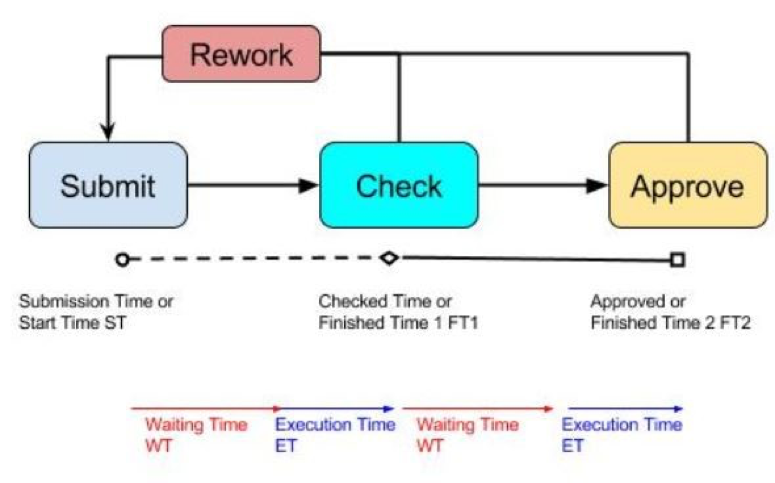
Do the checkers start checking as soon as a new Check Request is submitted? Surely not, therefore there is what I call a “waiting time”. The diagram can now include the Waiting Time and the Execution time (i.e the time it actually takes to “get on with the task”)

My previous average lead time of 5 days to Check can be split into Waiting Time WT and Execution Time ET if this can be measured. Be reassured it can be measured. Let’s say for the purpose of the discussion that the average WT and ET are respectively 4.5 days and 0.5 day to check. Therefore if I could reduce the WT, I would improve the lead time without having to change the process, the methodology, the technology etc in other words how the document is being checked.

The same applies for the lead time to approve the document.

What do we now know?

  • We can count the number of Reworks and the reasons. This allows to develop staff which in turn become more capable. As a consequence the number of rework reduces and the lead time is improved.
  • We can measure the duration and the ratio between Waiting Time and Execution Time. Waiting Time is nothing other than a waste of time, the customers do not pay for. It must, therefore, be reduced as much as possible or even better eliminated. The Waiting Time generally counts for the largest part of the lead time. This said, once the Waiting Time has been significantly improved and the Execution Time counts for most of the lead time, there are ways to reduce it too. Generally, the Waiting Time is the low hanging fruit.

How can we count and measure?

An Excel spreadsheet could do the job but that would not be that efficient. Imagine asking every participant to open the Excel log sheet and enter the date and time, etc.. Imagine to input all the data in Excel. This is even without mentioning when the file is locked by another user. Clearly, while it is possible to capture the information, Excel is not the right tool (system) to use.

This is the component System of the discussion.

It is important to use the right system that will not only support the business process but also capture the information seamlessly. E.g The user submits the document to be checked and approved. The counter starts automatically to count the waiting time and the checker is automatically notified of the new request. The checker, when ready to start checking, clicks on a button to acknowledge the start of the Check. The system automatically stops measuring the Waiting Time which is now over and starts measuring the Execution Time. When the Checker clicks on the Checked OK button, this completes the duration of the Check Activity and this is automatically recorded.

You get the picture.

Using the appropriate system to manage the process is key to be able to efficiently measure the performance of the process and staff. Having the right technology allows seamless access to precious management information.

Is that enough? Could there be still something else to learn?

Yes, let’s assume that the appropriate technology has been selected and it is proven that 80% of the approval activities can be automated by using rules in the system. This simplifies the Approver’s task as now only 20% of it requires a manual review. Nonetheless, we saw that every time a new task is introduced in a process, a new Waiting Time is introduced. Maybe those 20% can be moved to the Check Activity. This requires the Checker to be trained and given more responsibility in other words empowering the Checker. Consequently the approval task could be removed. This simplifies the process, improves lead time etc….

Is there still something else to learn from it?

Yes, again.

The progress and performance could be put in a visual form, a graphic called CFD (Cumulative Flow Diagram). CFD, again with the right technology, can be built automatically without any user intervention based on the data recorded automatically. CFD gives in real time the evolution of the process with the volume of requests at a given point and gives a visual indication of the workload and lead time.

Is that all? No. CFD, once mastered, can also provide important information on the trend and help identify potential bottlenecks in the near future.

Conclusion

Based on a very simplistic process, it was explained how much can be learnt effortlessly if the right technology is used in order to improve the performance. It has been seen that PeopleProcess and Technology are very much linked together in order to provide business improvement.

We saw

  1. how we can learn to improve staff
  2. how we can identify waste of time in a process
  3. how the technology helps to capture essential information effortlessly

Do you think there are still things to learn based on that example to continue improving performance and reduce lead time? Yes indeed, but that will be the topic of a new article. In the meantime have a guess in the comments section.

All companies have processes. They can be formal or informal, supported by an IT system(s) or not. However, many companies, regardless of their size, do not make the most of their processes to really learn from them and drive improvement. Here are some food for thoughts to develop a methodology for improvement.

Let’s take a very simple process for approving documents:

and a RACI matrix is also created. eg:

This is nicely documented in the company QMS and this will therefore tick the box of an ISO 9001 audit. After all a process is defined and the staff knows it.

However, how is it used in practice?

Do people print out the document and give it to the Checker, or maybe send him/her an email with an attachment asking him or her to check it?

  • How can the performance of this process be measured?
  • How can the staff competence be improved?
  • How do you ensure the right technology is used to support it?

Let’s see how those questions can be answered.

This process can teach us the following:

  1. Duration (lead time) for the document to be approved.
  2. Number of Rework necessary to have it Checked OK and Approved. In an ideal world no rework should be necessary, i.e checked and approved first time.

The duration between the submission and when the document is Checked OK and between Checked OK and Approved can be measured. Let’s call it lead time. Now, imagine there is enough data to calculate an average and let’s take 5 days to check a document and 2 days to approve it.

Therefore, we now know with confidence to allow an average of 7 days in the overall project plan / process for this approval activity.

Can something else be learnt?

We can count the number of reworks. If a submitter has a high number of reworks per submission, surely something can be done about it. But what?

The reason for each rework can be categorised e.g Cat 1, Cat 2 and Cat 3. If out of 100 new submitted documents, 80 are sent to Rework and out of those 80, 60 are due to reason Cat 2, 15 Cat 1 and 5 Cat 3. We now know that our submitter has a problem regarding Cat 2 and training can be organised to improve his/her competence. After training, we should be able to see that the reasons of rework are no longer due to Cat 2 and as Cat 2 is no longer a problem, the average lead time has been reduced.

This is the “people aspect”. An appropriate process that documents what is happening helps to improve people performance.

What else can be learnt from the process?

Do the checkers start checking as soon as a new Check Request is submitted? Surely not, therefore there is what I call a “waiting time”. The diagram can now include the Waiting Time and the Execution time (i.e the time it actually takes to “get on with the task”)

My previous average lead time of 5 days to Check can be split into Waiting Time WT and Execution Time ET if this can be measured. Be reassured it can be measured. Let’s say for the purpose of the discussion that the average WT and ET are respectively 4.5 days and 0.5 day to check. Therefore if I could reduce the WT, I would improve the lead time without having to change the process, the methodology, the technology etc in other words how the document is being checked.

The same applies for the lead time to approve the document.

What do we now know?

  • We can count the number of Reworks and the reasons. This allows to develop staff which in turn become more capable. As a consequence the number of rework reduces and the lead time is improved.
  • We can measure the duration and the ratio between Waiting Time and Execution Time. Waiting Time is nothing other than a waste of time, the customers do not pay for. It must, therefore, be reduced as much as possible or even better eliminated. The Waiting Time generally counts for the largest part of the lead time. This said, once the Waiting Time has been significantly improved and the Execution Time counts for most of the lead time, there are ways to reduce it too. Generally, the Waiting Time is the low hanging fruit.

How can we count and measure?

An Excel spreadsheet could do the job but that would not be that efficient. Imagine asking every participant to open the Excel log sheet and enter the date and time, etc.. Imagine to input all the data in Excel. This is even without mentioning when the file is locked by another user. Clearly, while it is possible to capture the information, Excel is not the right tool (system) to use.

This is the component System of the discussion.

It is important to use the right system that will not only support the business process but also capture the information seamlessly. E.g The user submits the document to be checked and approved. The counter starts automatically to count the waiting time and the checker is automatically notified of the new request. The checker, when ready to start checking, clicks on a button to acknowledge the start of the Check. The system automatically stops measuring the Waiting Time which is now over and starts measuring the Execution Time. When the Checker clicks on the Checked OK button, this completes the duration of the Check Activity and this is automatically recorded.

You get the picture.

Using the appropriate system to manage the process is key to be able to efficiently measure the performance of the process and staff. Having the right technology allows seamless access to precious management information.

Is that enough? Could there be still something else to learn?

Yes, let’s assume that the appropriate technology has been selected and it is proven that 80% of the approval activities can be automated by using rules in the system. This simplifies the Approver’s task as now only 20% of it requires a manual review. Nonetheless, we saw that every time a new task is introduced in a process, a new Waiting Time is introduced. Maybe those 20% can be moved to the Check Activity. This requires the Checker to be trained and given more responsibility in other words empowering the Checker. Consequently the approval task could be removed. This simplifies the process, improves lead time etc….

Is there still something else to learn from it?

Yes, again.

The progress and performance could be put in a visual form, a graphic called CFD (Cumulative Flow Diagram). CFD, again with the right technology, can be built automatically without any user intervention based on the data recorded automatically. CFD gives in real time the evolution of the process with the volume of requests at a given point and gives a visual indication of the workload and lead time.

Is that all? No. CFD, once mastered, can also provide important information on the trend and help identify potential bottlenecks in the near future.

Conclusion

Based on a very simplistic process, it was explained how much can be learnt effortlessly if the right technology is used in order to improve the performance. It has been seen that PeopleProcess and Technology are very much linked together in order to provide business improvement.

We saw

  1. how we can learn to improve staff
  2. how we can identify waste of time in a process
  3. how the technology helps to capture essential information effortlessly

Do you think there are still things to learn based on that example to continue improving performance and reduce lead time? Yes indeed, but that will be the topic of a new article. In the meantime do not hesitate to contact us if you believe your company needs efficiency improvement.

Menu